∴
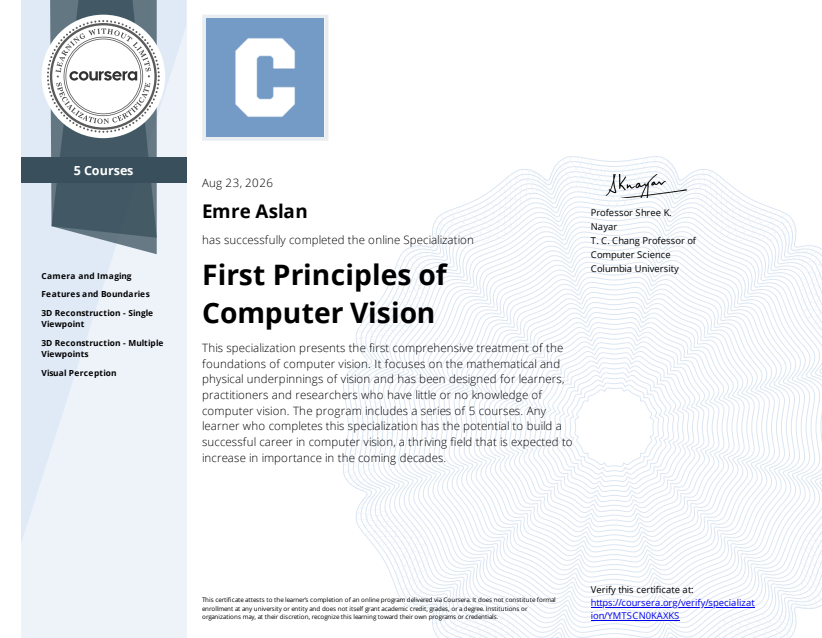
I completed the First Principles of Computer Vision Specialization by taking detailed notes and summarizing critical concepts for future reference.
Columbia University
Course & Note Overview
These notes document my systematic study of the First Principles of Computer Vision specialization taught by Prof. Shree K. Nayar at Columbia University. The notes bridge physical optics, sensor physics, 3D projective geometry, and modern machine perception to build a complete bottom-up understanding of how computers interpret the visual world.
| # | Course / Area | Core Focus & Note Contents |
|---|---|---|
| 1 | Introduction to Computer Vision | Computational vision foundations, human visual pathways, pixel representation, and foundational image pipelines. |
| 2 | Imaging & Sensor Physics | Pinhole camera models, optics & depth of field, CCD/CMOS sensor noise, dynamic range, HDR imaging, and Fourier frequency filtering. |
| 3 | Features & Boundaries | Gradient operators, Canny edge detection, Hough transforms, SIFT keypoints & descriptors, homography, RANSAC, and image stitching. |
| 4 | 3D Reconstruction (Single View) | Radiometry & BRDF reflectance models, photometric stereo, shape from shading, depth from defocus, and active structured light. |
| 5 | 3D Reconstruction (Multi-View) | Epipolar geometry, stereo disparity, multi-view 3D reconstruction, Structure from Motion (SfM), and optical flow motion estimation. |
| 6 | Perception & Visual Learning | Color spaces, human visual perception, neural networks for vision, feature hierarchies, and modern visual recognition. |
— emreaslan —